Graduate Program: MSCE, Center for Clinical Epidemiology and Biostatistics (2004)
Current Title: Professor and Vice Chair for Research, Department of Family Medicine and Community Health, Perelman School of Medicine
Location: Philadelphia, Pennsylvania
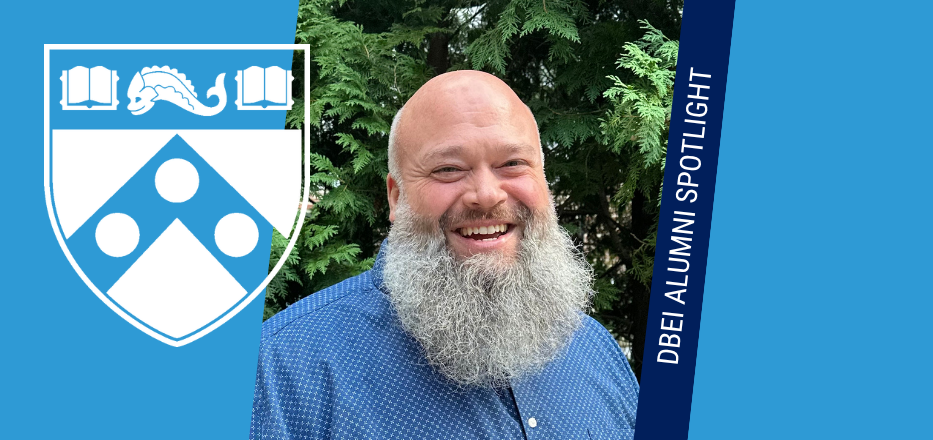
Peter F. Cronholm, MD, MSCE, CAQHPM, is a graduate of the Master of Science in Clinical Epidemiology (MSCE) program at the University of Pennsylvania. Before entering the MSCE program, Dr. Cronholm earned a BS from the University of Delaware in 1994, followed by an MD from Temple University School of Medicine in 1998. During his training, he was mentored by Marjorie Bowman, David Nicklin, Fran Barg, Judy Shea, Judith Long, and Rich Wender.
Today, Dr. Cronholm is a Professor and Vice Chair for Research in the Department of Family Medicine and Community Health at the University of Pennsylvania.
We reached out to Dr. Cronholm to learn more about his current work and to invite him to reflect on his time as a student in the MSCE program at Penn.
Why did you choose the MSCE Program?
I entered a degree-granting faculty development fellowship and wanted to be prepared for a career as a clinical researcher. The MSCE program was ideal training for what I needed professionally at that time in my career.
What was the most meaningful part of your experience in the program?
My MSCE training helped provide a skill-based approach to problem-solving for moving from concept to question, to design, to implementation in a coherent and thoughtful manner.
What faculty member, mentor, or course was most influential for you and why?
Henry Glick and Sankey Williams’s Clinical Economics and Decision Making course was the best course I have ever taken. The course provided useful frameworks and analytic approaches to answer the questions driving meaningful change. The course and professors helped shape the way I think about issues to this day.
What is a typical day like in your role?
I am 20% clinical, spending one day per week seeing patients which is split between precepting and seeing my continuity patients. The rest of my week is divided between mentee, project-related, and administrative meetings. I am a collaborative researcher often balancing more than a dozen grants where I help support teams with qualitative and mixed-methods approaches for evaluation and implementation and engaging patient and community partners in research. On any given day, I problem solve issues for the Mixed Methods Research Lab which is a University Service Center I co-developed and direct which oversees 60+ projects annually.
What do you value most about your current role?
I enjoy mentorship the most. I am always working on how to be a better mentor, coach, and sponsor given the needs of my early-career colleagues. I value having kept strong in research, clinical work, and teaching over the years and appreciate how those pillars interact and inform each other.
What advice would you offer a current or aspiring student?
Seek out mentors with intention. Be an active mentee and come to the table with an agenda to help your mentors know how they can best be of service to you and your career. Know that you will need many mentors unless you are good at finding unicorns who possess all of the skills and learnings you need advice and guidance on.
What is on the horizon for you in terms of your career goals or research path?
I am focused on trying to elevate and position, and impact of primary care research around the content and processes that define what is unique about our profession and its role in improving the health of our nation.
Please share anything else you think would be interesting or valuable for others to know.
When I was early in my career, I spent too much time feeling like an imposter and assuming unfriendly intentions of those around me. My experience transformed when I shook off those assumptions. I continue to be impressed with how genuinely smart, open, and kind so many of our colleagues are on this campus.